
9 minute read
The Korean Lash Lift has taken over the lash industry worldwide and for good reason. This new technique delivers healthier, longer-lasting results compared to the traditional lash lift, and it’s quickly becoming a favourite among lash artists who want better control, easier lash wrapping, and a stronger, root-to-tip lift.
Whether you're new to the method or want to understand why it has gone so viral, here’s everything you need to know.

What Is a Korean Lash Lift?
A Korean Lash Lift is an advanced lifting technique that typically avoids using glue or balm. The process begins by softening them with Step 1 on a flat shield. To give Step 1 a stickier texture, it’s often mixed with thickening powder or a viscosity-modifying gel, making it easier for lashes to stay in place during softening.

Once the lashes have softened and become flexible, the steps are:
- Remove Step 1 cream completely
- Switch from the flat shield to your main curl lifting shield
- Wrap the softened lashes neatly onto the curl shield, keeping them straight with no crisscrossing
- Apply Step 2 cream to set the curl
It might seem like there are more steps at first glance, but with a bit of practice, this method becomes quicker, cleaner, and far more precise. The result is a beautifully lifted, uniform lash line the signature look of a Korean Lash Lift.

Why Is the Korean Method Better Than the Traditional Method?
1. Easier Lash Wrapping & Less Damage to Lashes
With the traditional method, once glue is applied, any adjustments often tug or pull on the lashes, increasing the risk of stress and damage.
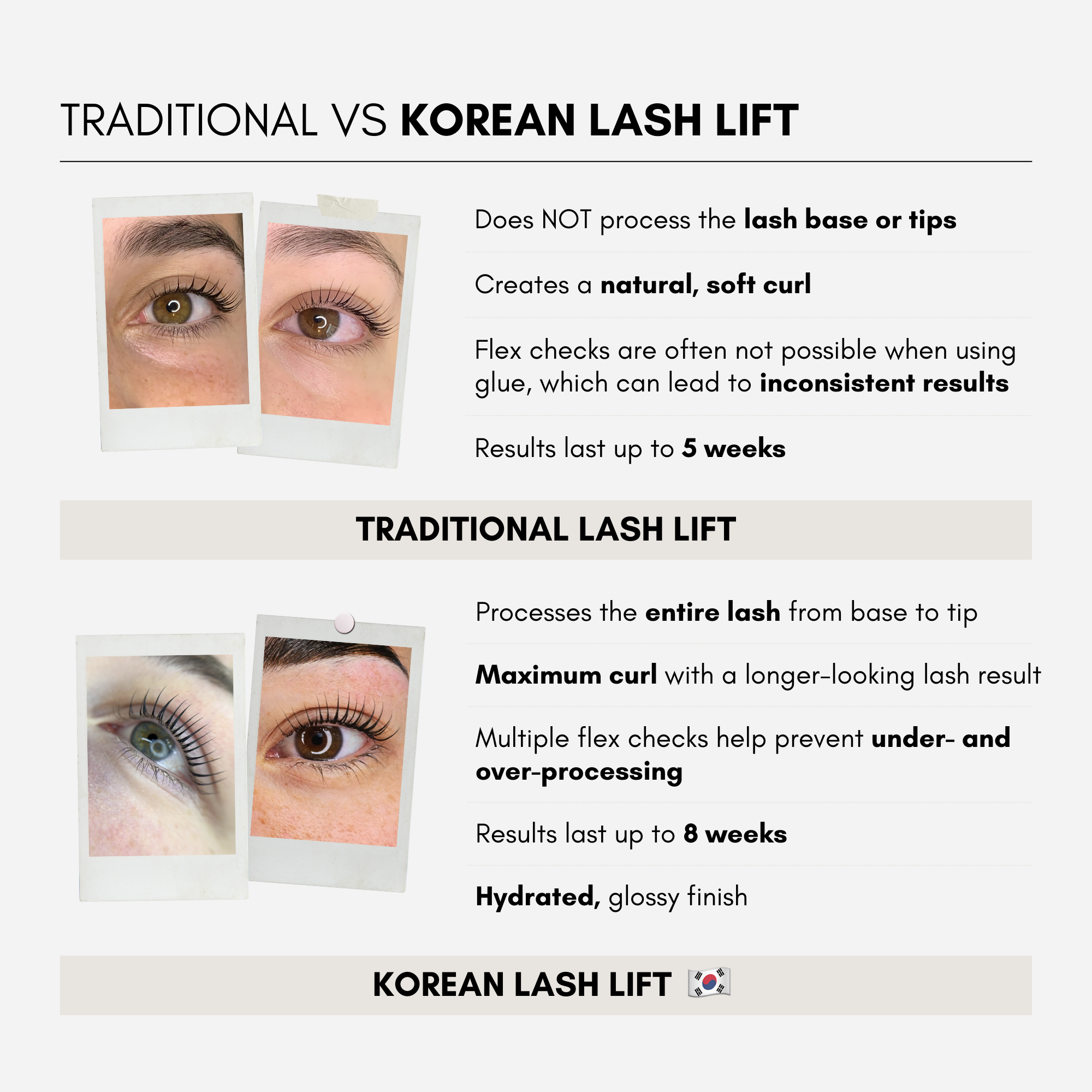
With the Korean method, Step 1 cream is applied first without using glue. This softens the lashes, making even thick, coarse lashes far more flexible and much easier to wrap onto the shield. As a result, wrapping is quicker, smoother, and requires far less force.
In many cases, there’s no need to use glue or glue balm at all, especially when a hydrating cream such as Re;Vive is used as a replacement.

2. A completely different finish
Korean lash lifts raise the lashes right from the very base, creating maximum visible length and a more dramatic lift.
The traditional method can’t always reach the root due to the curl shield blocking visibility, often leaving a small gap. Korean flat shields eliminate that issue.

How Long Does a Korean Lash Lift Last?
A standard lash lift generally lasts around 4-6 weeks, depending on the lash cycle. Korean lash lifts, however, tend to last even longer.
Why? Because the lashes are lifted from the root, giving a stronger, more defined curl that stays visible for a longer period.
How Do I Know When Step 1 (Softening Cream) Is Ready to Remove?
Watch for these indicators:
- The lashes appear less shiny with minimal light reflection.
- The colour becomes lighter, slightly brownish.
- When gently bent with tweezers, the lashes form a V shape, not a U.
- When moved at the base, the lashes stay in place rather than springing back.
- Once wrapped onto the shield, no lashes pop off.
These signals matter more than the suggested timing always check in real time.

Should Korean Lash Lifts Only Use Cysteamine-Based Products?
Not at all! Many leading Korean lash artists use TGA-based formulas, and it’s perfectly safe to process the entire lash with TGA as long as:
- you control where you place the cream,
- monitor the lashes closely, and
- never rely exclusively on timing charts.
Alba’s Re;Set Lash Lift System uses a hybrid of Cysteamine and TGA:
- Cysteamine → gentle, less damaging, keeps lashes healthy
- TGA → fast processing, strong, long-lasting curl
Together, they create a bouncy, healthy lift from root to tip — giving you the best of both worlds.
Please note Korean lash lifts are not just about using 'different' or 'better' lash lift supplies. It’s more about learning a new skill and technique.
Is the Korean Lash Lift Not Suitable for Weak or Fine Lashes?
Totally suitable! Many Korean clients naturally have fine, delicate lashes, and this technique is designed exactly for that.
The key to achieving safe, beautiful results is:
- Controlling how much Step 1 cream you apply
- Monitoring the lashes closely with flex checks throughout the treatment
- Avoiding leaving the cream on the tips the entire time — a few minutes is plenty
Weak or fine lashes can lift beautifully as long as the artist works mindfully and adjusts the process with care.

Can I Use Lifting Glue or Balm in a Korean Lash Lift?
Yes using lifting glue or glue balm is still completely acceptable.

While many Korean artists prefer thickening powder during Step 1, others still use glue or glue balm, especially before Step 2, to secure the lashes perfectly onto the shield.
However, if some lashes keep lifting off the shield before Step 2, that usually means they weren’t fully softened in Step 1. Simply reapply Step 1 and allow a bit more time.
What’s the Difference Between “Korean” and “Glueless” Lash Lifts?
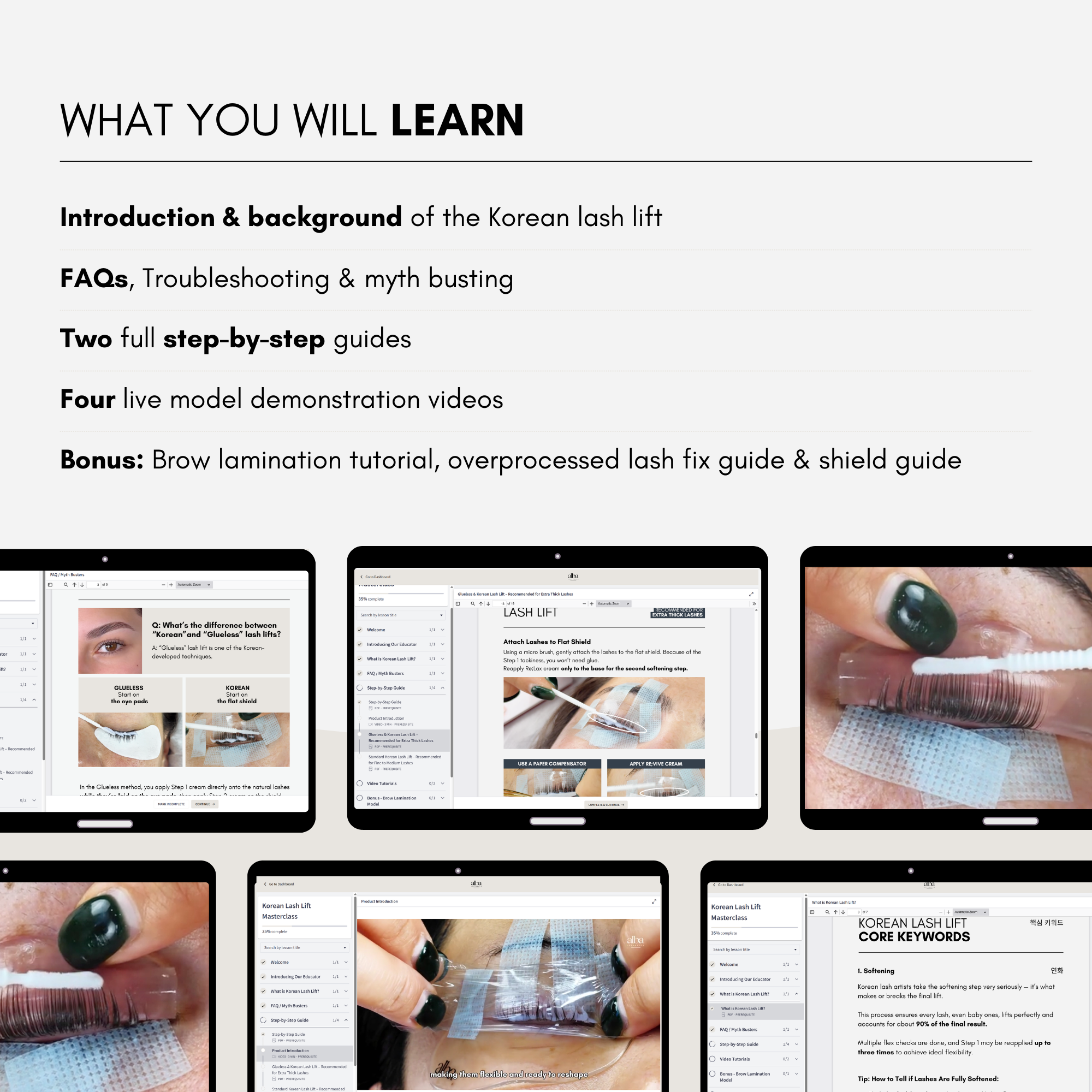
Glueless Lash Lift Method
- Step 1 is applied directly to the lashes while they are resting on the under-eye pads.
- Once the softening process is complete, remove the under-eye pads, attach the curl shield to the eyelid, then wrap the lashes and apply Step 2 cream.
Korean Lash Lift Method
- Lashes are lifted onto a flat shield during the softening stage.
- Once softening is complete, the flat shield is swapped for the curl shield, the lashes are wrapped neatly, and Step 2 is applied.
You can also combine both techniques, which works exceptionally well for clients with very thick or coarse lashes especially when the lashes feel too firm to attach straight onto a flat shield.
The approach is simple:
- Start with the glueless method to begin softening.
- Once the lashes are about halfway softened, lift them onto the flat shield to complete the softening stage.
- Then switch to your curl shield to wrap and continue as normal.

Do I Have to Use Cling Film for Step 1 for Korean Lash Lift?
It’s not mandatory but highly recommended, especially for medium to thick lashes. Cling film prevents air exposure, enhances product absorption, and ensures even processing. It also keeps the solution from drying out, improving overall results.
What Do I Do When Korean Lash Lift Results Are Underwhelming or the Curl Turns Out Uneven?
- Incorrect Rod or Shield Size: Using a lash lift rod or shield too large for the natural lash length can lead to minimal lift. Opt for smaller sizes for shorter lashes to create a dramatic curl.
- Shield or Lash Placement Issues: Ensure the shield is attached close to the lash line, and lashes are securely and tightly wrapped on the shield, straight, separated, and evenly spaced without crisscrossing.
- Under-Processing: Leaving the lifting or setting solution on for too short a time can result in an underwhelming lift. Follow the recommended timing guidelines, adjusting slightly for thicker or finer lashes as needed.
- Incorrect Application of Solutions: Solutions must be applied evenly, fully covering the lashes from root to tip.
- Excess Glue or Glue Balm: Using too much lash lifting adhesive can create a barrier, blocking the solution's performance. Apply just enough and smooth it out thinly with an applicator. You can use cling film or a lash compensator to prevent the baby lashes from falling off the shield, instead of applying more glue.
- Uneven Eye Shape: Clients may naturally have different eye shapes or lash growth patterns. Use different shield sizes or adjust timing to compensate.
What to Do If Lashes Become Over-Processed
Over-processed lashes can happen to any lash artist, even with experience. The key is knowing how to recognise it early, prevent it, and correct it safely.
How to Tell If Lashes Are Over-Processed
Lashes may be over-processed if you notice:
- Lashes curling too tightly
- Tips curling back and touching the eyelid
- Lashes looking thin and weak
This usually means Step 1 cream was left on for too long.
Why Over-Processing Happens
1. Relying Only on Timing Guides
Timing charts are a guide, not a rule. Every client’s lashes are different.
Always perform a flex check instead of relying solely on recommended times.
2. Natural Lash Differences
- Some lashes look fine but are actually very healthy and stubborn
- Some lashes look thick but may be low porosity and process very quickly
- Lashes that were lifted recently may appear strong but are already damaged. In these cases, Step 1 must be left on for a much shorter time.
3. Lash Tips Process Faster
Lash tips are naturally thinner than the base, so they soften much faster.
Over-processing almost always happens at the tips first.
How to Prevent Over-Processing
Apply Step 1 Strategically
- Use more product at the base
- Use very little to almost no product on the tips
- For very fine tips, lightly brushing over them is enough
A thicker layer of step 1 cream processes faster and stronger, so control matters.
Wipe the Tips Early
Wipe Step 1 off the tips earlier than the base.
Once wiped, apply Re;Vive cream to:
- Rebalance the pH quickly
- Stop the softening process
- Protect the fragile tips
What to Do If Lashes Are Already Over-Processed
If the client would like the lashes re-done, it can be done safely with care.
Re-Lifting Over-Processed Lashes
- Apply Step 1 sparingly
- Start checking softness from around the 2-minute mark
- Use a brush to gently touch the lashes and assess flexibility
- Apply little to no Step 1 on the tips, just light brushing
As soon as the lashes feel soft:
- Wipe immediately
- Wrap lashes onto the shield
- Proceed with Step 2 using the minimum processing time
Extra Care at the End
- Leave Re;Vive on separately for around 5 minutes for extra hydration and nourishment
- Use a much larger lifting shield to avoid excessive curl
Aftercare Recommendations for Clients
- Recommend a lash growth serum to support faster, healthier regrowth
- Advise the client to be as gentle as possible with their lashes
- Avoid rubbing, excessive heat, or harsh cleansing
Final Thoughts
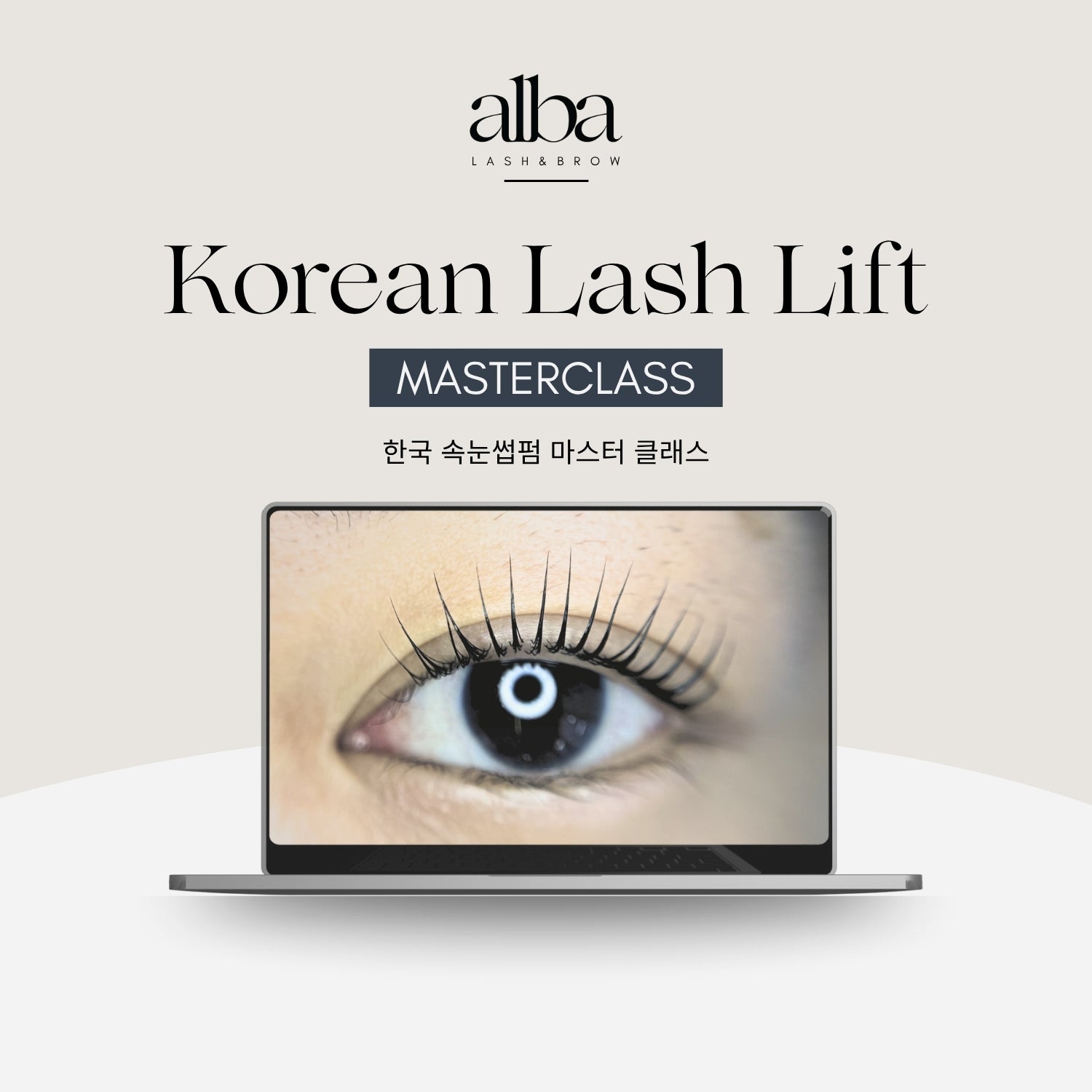
If you’d love to dive even deeper into the Korean method, good news we offer a free Korean Lash Lift Masterclass.
Enrol today and take your skills to the next level!