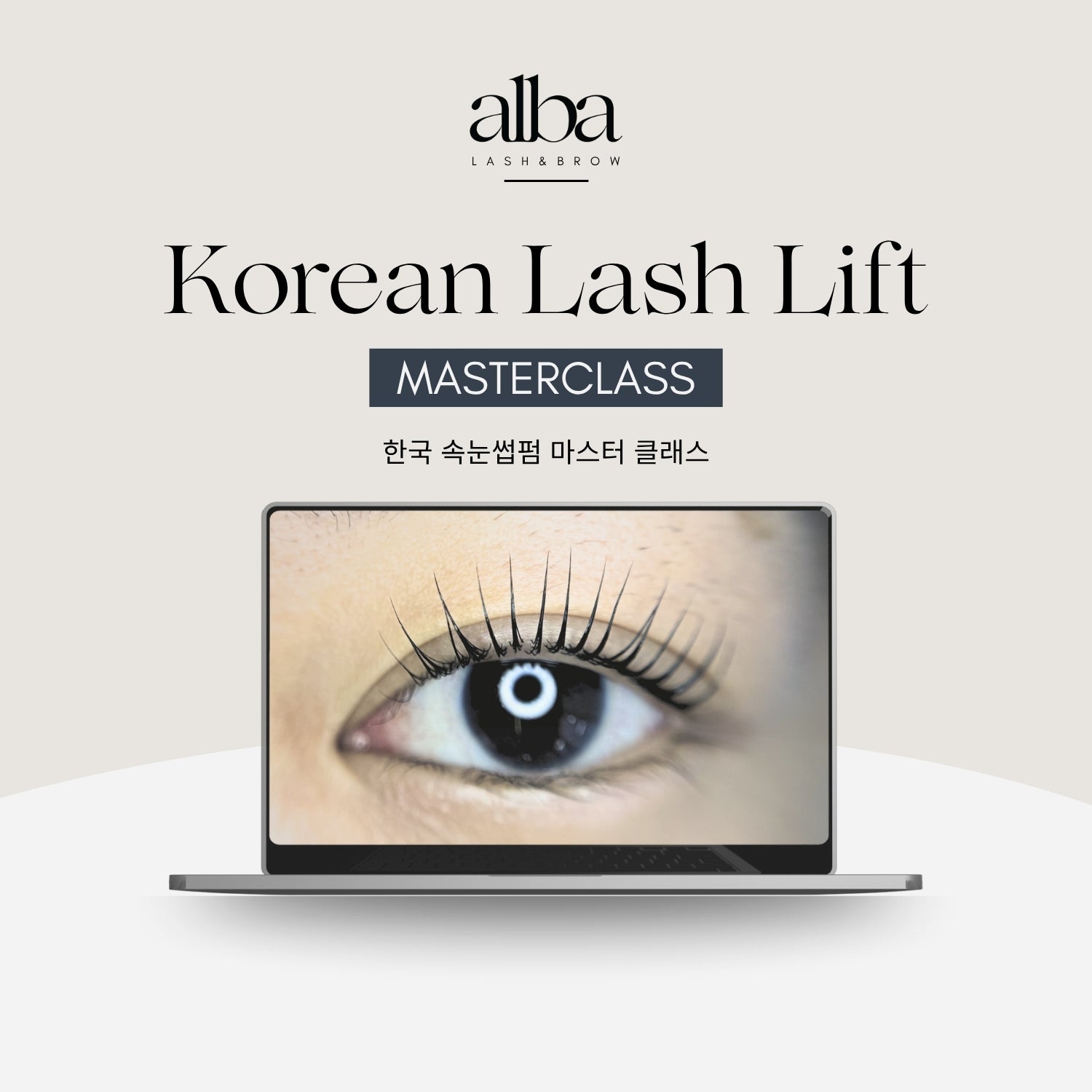

A Korean lash lift is a professional treatment that softens, reshapes and sets your natural lashes so they lift from the root. It is known for creating a clean, open-eyed finish that makes the lashes look longer without adding lash extensions. The method often softens the lashes before they are wrapped onto the final lash lift curl shield, giving the artist more control over stubborn, short or downward-growing lashes.
But “Korean lash lift” does not describe one universal product, ingredient or curl. It is a technique family. It may be glueless, but it does not have to be. It may use cysteamine, thioglycolate (TGA) or a hybrid formula. The quality of the result still depends on the artist's assessment, product placement, timing, lash lift shield choice and aftercare.
This guide answers the most common questions about Korean eyelash lifts, including how long they last, whether they damage lashes, who should avoid the treatment, what they cost and how they compare with traditional lash lifts and extensions.

What is a Korean lash lift?
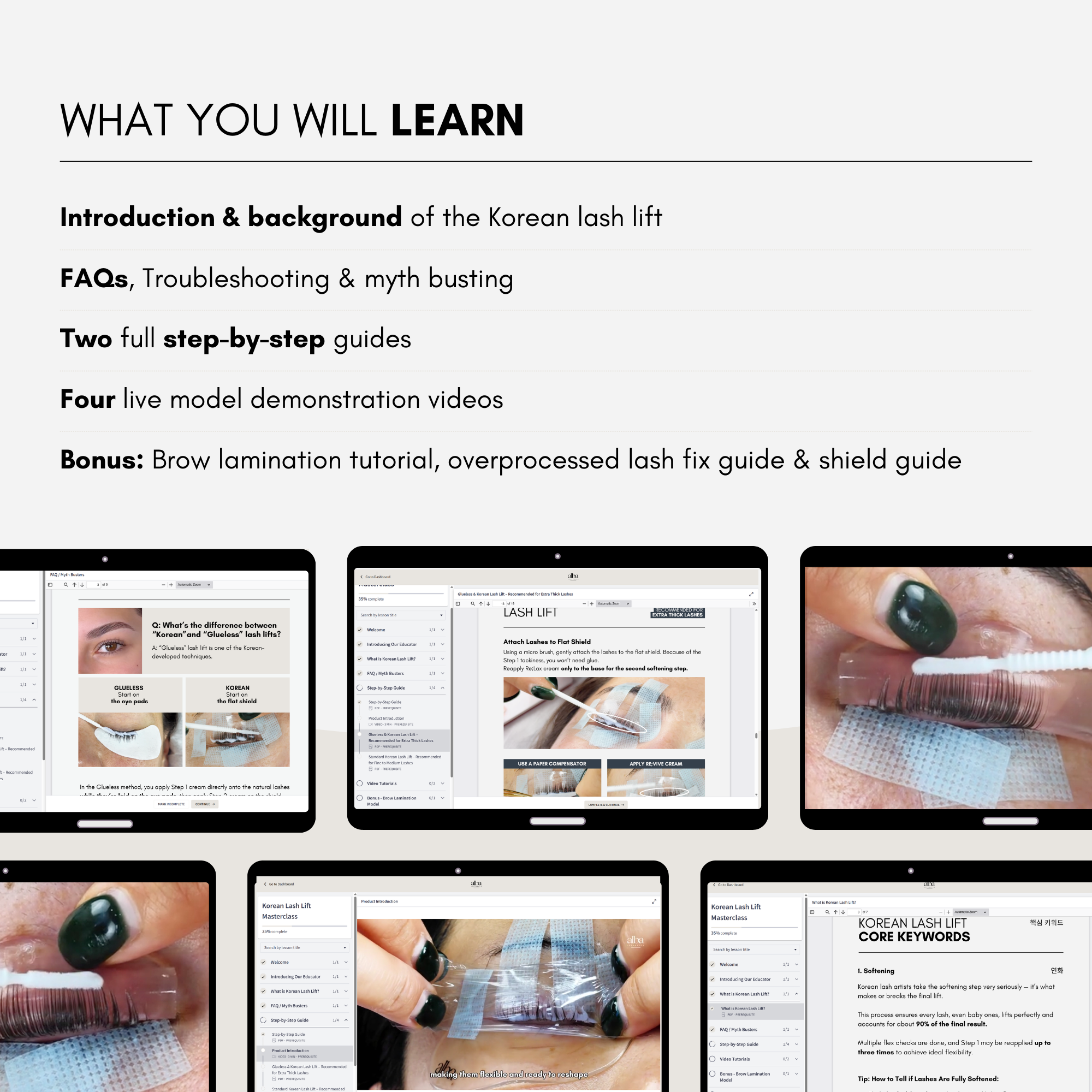
A Korean lash lift is an advanced lash-lifting method that focuses on controlled softening and a visible lift from close to the root. In many versions of the technique, Step 1 is applied while the lashes are resting on an under eye pad or flat shield. Once the lashes have softened and become flexible, the artist transfers them to a curved shield, carefully aligns them and applies Step 2 to set the new shape.
Because the lashes are softened before the final wrap, thick or downward-growing lashes can be easier to position without repeatedly pulling against them. Flat shields also give the artist a clear view of the base, which can create a strong root lift and more visible length.
Is a Korean lash lift glueless?
It can be, but “Korean lash lift” and “glueless lash lift” are not identical terms. Many Korean methods use a thicker lifting solution, viscosity gel or viscosity powder to hold the lashes during softening, so traditional lash lift glue may not be needed. Other artists use a small amount of glue or glue balm during the final wrapping stage. The defining feature is the processing and shaping approach, not a strict no-glue rule.
What is the difference between a glueless lash lift and a Korean lash lift?
“Glueless” describes how the lashes are held in place. “Korean” describes the wider technique. A glueless lift may be performed with or without a flat shield and may not use Korean root-lifting or softening methods. A Korean lash lift may be completely glueless, partly glueless or performed with adhesive, depending on the artist and system.
Korean lash lift vs traditional lash lift: what is the difference?
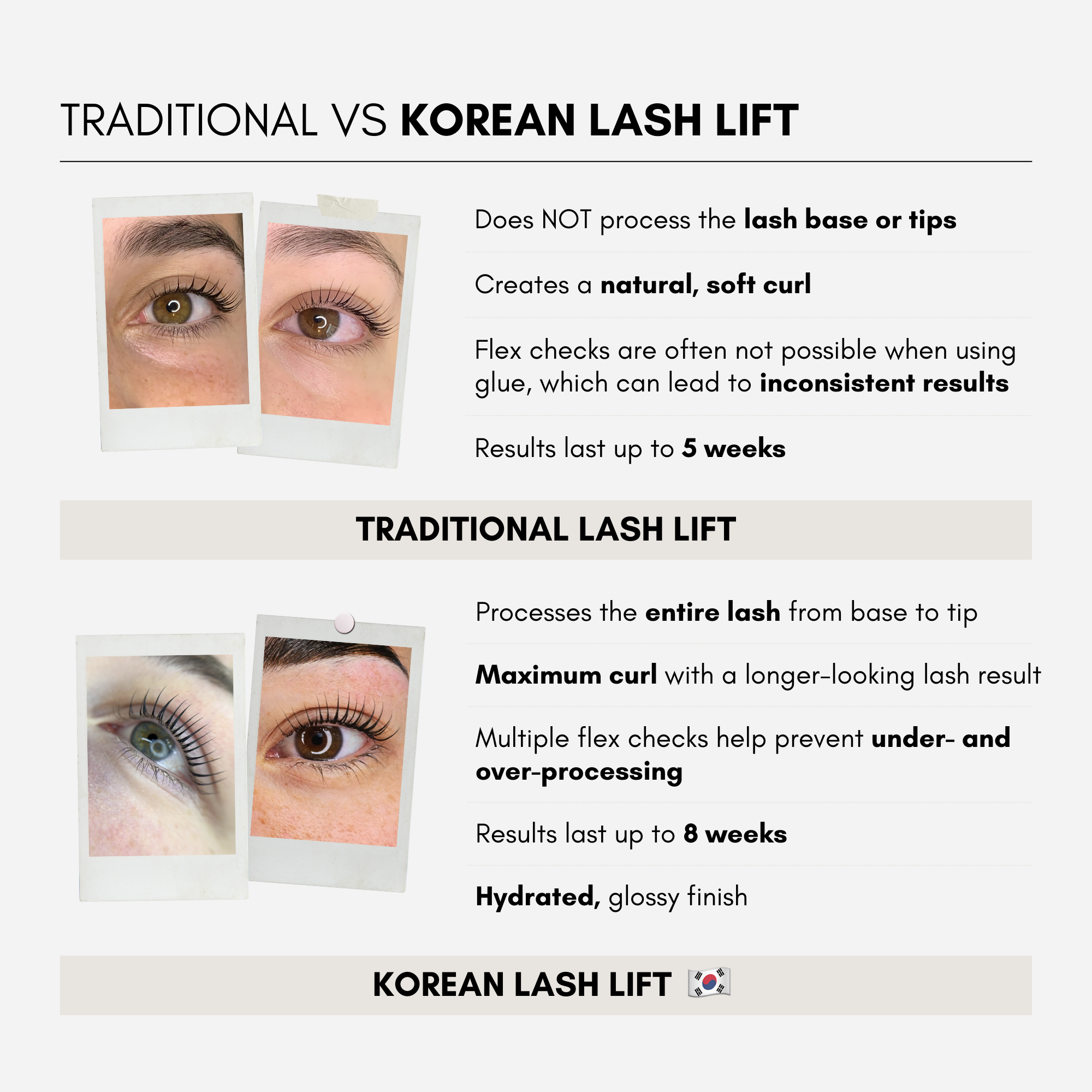
The main difference between a Korean lash lift and a traditional lash lift is usually the treatment sequence. In a Korean lash lift, the lashes are often softened before the final wrapping stage, sometimes using a flat shield. With a traditional lash lift, untreated lashes are typically attached directly to a curl shield before Step 1 is applied.
Because softened lashes are more flexible, Korean lash lift techniques are often glueless or require only a small amount of adhesive. This can make the lashes easier to align and wrap neatly. A flat shield may also provide clearer visibility and easier access to the root area. In a traditional lift, glue or balm is generally used to secure the untreated lashes, and coarse or resistant lashes may be more difficult to attach initially.
Korean lash lifts are often associated with a clean, elongated finish and a strong lift from the root. Traditional lash lifts can create anything from a soft curve to a more dramatic curl, depending on the shield and technique used.
However, the formula itself does not define whether a treatment is Korean or traditional. Both methods may use cysteamine, TGA or a hybrid formula.
Neither method guarantees one specific result. A well-performed traditional lash lift can look soft and healthy, while a poorly performed Korean lash lift can still result in over-curled or damaged lashes. Ultimately, accurate processing, careful technique and a curl design suited to the client’s natural lashes and eyelids matter more than the treatment label.

Is a Korean lash lift better than a regular lash lift?
It can be better for certain lashes and desired results, but it is not automatically better for everyone. Korean lash lifting is especially useful when the client has straight, strong or downward-growing lashes and wants maximum visible length from the root. Artists may also find softened lashes easier to wrap neatly.
Potential advantages include:
1. A strong root lift with less visible gap at the base
2. Easier wrapping of coarse or stubborn lashes after softening
3. More control over direction, separation and the final silhouette
4. Less need to repeatedly tug against untreated lashes during the initial wrap
5. A naturally elongated look without extensions
What are the downsides of a Korean lash lift?
The main disadvantages are:
- It requires specific Korean lash lift training and careful real-time assessment; copying a viral video is not enough.
- The extra softening, transfer or flat-shield stages can feel more complex while an artist is learning.
- Terminology is inconsistent, so two salons may offer different services under the same name.
- The result is limited by the client's natural lash length, density and growth pattern.
- Like every chemical lash lift, it carries risks of irritation, allergy, over-processing and breakage if performed incorrectly.
- A very strong root lift may be unsuitable if the lashes would touch the eyelid or if the client prefers a soft curl.
What are the downsides of getting a lash lift in general?
Any lash lift is semi-permanent, so you cannot simply wash it off if you dislike the shape. Results also grow out unevenly as untreated new lashes appear beside lifted lashes. You will need to avoid frequent reprocessing, and a tint may fade sooner than the lift. There is also a small but important risk of skin or eye irritation because lifting products are used close to the eyes.
How do Korean lash lifts look before and after?
Before a Korean lash lift, the natural lashes may point straight forward or downward, making their full length difficult to see from the front. After the treatment, the same lashes should look lifted from close to the root, evenly separated and visually longer. The eyes often look more open, even without mascara.
A good result should complement the eye rather than force every lash into the sharpest possible angle. Depending on the shield, the finish can be straight and editorial, softly curved or more dramatic. It should not look frizzy, kinked, crossed or crushed against the eyelid.

Can a Korean lash lift be performed on short or downward-growing lashes?
Yes. In fact, short or downward-growing lashes are often excellent candidates because lifting from the base reveals length that was previously hidden. The artist must choose a shield that supports the desired lift without creating a hook at the tip. Very short, sparse, fragile or actively shedding lashes should be assessed individually before treatment.
How long does a Korean lash lift last?
Most Korean lash lifts remain noticeable for around six to eight weeks. The lift gradually changes as treated lashes shed and new, untreated lashes grow in. Some clients feel that a Korean lift looks visible for longer because the lashes were lifted close to the root, but longevity is not guaranteed by the technique name alone.

How long your result lasts depends on:
- Your natural lash growth and shedding cycle
- The condition, thickness and resistance of your lashes
- The artist's processing, shield choice and root placement
- Exposure to heat, steam, rubbing and heavy waterproof makeup
- Following the aftercare recommended for the system used
How often can you get a Korean lash lift?
Appointments are commonly spaced about six to eight weeks apart, and sometimes longer if the lashes are dry, weak or still heavily lifted. Rebooking should be based on healthy new growth and lash condition, not only the calendar. Reprocessing too soon can overlap chemicals onto previously lifted lashes and increase dryness or breakage.
How long does a Korean lash lift appointment take?
Allow roughly 60 minutes. Consultation, lash cleansing, shield selection, softening, wrapping, setting, tinting and finishing all take time. A simple service may be faster, while strong lashes or a detailed correction may take longer. Processing should never be rushed just to meet a fixed appointment time.
How much does a Korean lash lift cost?
In Australia, a Korean lash lift commonly costs around AUD $80 to $180, often including a tint, although premium salons or highly experienced artists may charge more. Pricing varies by city, inclusions, appointment length and artist experience. Choose based on training, hygiene, consultation and consistently healthy results rather than the lowest price.
Is a Korean lash lift safe for natural lashes?
A Korean lash lift can be performed safely on suitable lashes by a trained professional, but no chemical lash treatment is completely risk-free. Step 1 temporarily changes bonds within the lash hair so it can be reshaped; Step 2 then sets the new form. Excessive processing, incorrect placement, incomplete removal or poorly timed repeat services can leave lashes dry, brittle or broken.
Products must stay out of the eye and off the waterline. Redness, swelling and rash can indicate irritation or an allergic reaction. A patch test may help identify some sensitivities, but it cannot guarantee that a reaction will not occur around the eye. Anyone with persistent pain, marked swelling, light sensitivity or vision changes after a service should seek prompt medical care.
Will a Korean lash lift damage lashes?
It should not cause obvious breakage when the lashes are healthy, correctly processed and given enough time between services. However, the treatment does chemically alter the hair, so damage is possible. Korean technique is not a damage-proof label. The artist's control of timing, product amount, placement and tension is what makes the biggest practical difference.
What is the least damaging lash lift?
The least damaging lash lift is a customised service that uses the minimum effective processing for the client's actual lash condition. No single ingredient, country of origin or “gentle” claim makes a system automatically safest.
A lower-risk professional service should include:
- A consultation covering allergies, eye health, recent treatments and previous lift history
- Accurate lash assessment instead of relying only on a fixed timing chart
- Real-time flexibility or softening checks
- Controlled product placement, especially on fine tips and previously processed areas
- A shield shape and size that prevent over-curling or eyelid contact
- Complete removal and neutralisation according to the manufacturer's directions
- Adequate time between appointments and regular conditioning aftercare
Who cannot get a lash lift?
A lash lift should be postponed if you have an active eye infection, conjunctivitis, a stye, inflamed eyelids, broken or irritated skin around the eyes, or a known reaction to lifting or tint products. Clients with severely compromised lashes should wait until the lashes recover. Recent eye surgery, ongoing eye disease, persistent dry-eye symptoms or medically sensitive conditions should be discussed with the treating clinician before booking.
Pregnancy is not automatically a universal contraindication, but salon policies and product guidance differ. Hormonal changes can also make processing less predictable. Tell the artist before the appointment and follow medical advice if you have concerns.

What are signs of a bad lash lift?
Signs of a poor or over-processed result include:
- Dry, rough, frizzy or unusually brittle lashes
- Sharp bends, hooks or tips curling back into the eyelid
- Crossed, clumped or uneven lash direction
- Noticeable breakage or shortened tips
- One eye lifting very differently from the other
- A result that drops immediately because the lashes were under-processed or not set correctly
- Burning, persistent redness, swelling, discharge, pain, light sensitivity or blurred vision

Do eyelashes grow back after a lash lift?
Yes. A lash lift changes the visible hair shaft; it does not normally stop the follicle from producing new lashes. Treated lashes eventually shed as part of the natural cycle and are replaced by new lashes with their original growth pattern. If lashes have broken from over-processing, the visible recovery can take weeks to months because eyelashes grow in staggered cycles. Ongoing gaps, pain or abnormal loss should be assessed by a health professional.
What is the aftercare for a Korean lash lift?
Always follow the instructions given by your artist for the exact system used. Lash-lift aftercare advice can differ between brands. For the first 24 hours, many salons recommend avoiding water, steam, heavy sweating, eye makeup and pressure on the lashes. After that initial period, gentle cleansing is important for healthy eyelid hygiene.
For longer-lasting, healthier-looking results:
- Do not rub, pull or sleep with the lashes crushed against the pillow.
- Avoid very hot steam, saunas and prolonged heat during the initial setting period.
- Clean the eye area gently and brush lashes into place with a clean spoolie.
- Use a nourishing lash aftercare serum once your artist says it is appropriate.
- Choose easy-to-remove makeup and minimise the friction needed for removal.
- Do not use a mechanical lash curler on freshly lifted lashes.

Can I get my lashes wet after a Korean lash lift?
Yes, after the initial aftercare window recommended by your artist. Alba's current professional guide advises avoiding water and moisture for the first 24 hours. Other professional systems permit water sooner, so system-specific instructions take priority. After the first day, normal gentle cleansing will not wash away a correctly completed chemical lift.
Can I wear mascara with a Korean lash lift?
Yes. Once the first 24 hours have passed, you can wear mascara if the salon's instructions allow it. A water-based, non-waterproof formula is usually the easiest option because it can be removed with less rubbing. Many clients find that a lift and tint provides enough definition without daily mascara.
Korean lash lift vs lash extensions: which is better?
A Korean lash lift reshapes and lifts your existing natural lashes, while lash extensions add synthetic fibres to create extra length, density and a more customised style.
A Korean lash lift is best suited to clients who already have enough natural lashes and want a lightweight, low-maintenance result. Because nothing is attached to the lashes, they feel completely natural and usually require another treatment only every six to eight weeks. The result is typically clean, open-eyed and elongated.
However, a lash lift cannot add more lashes than you naturally have. If your main goal is greater density, extra length or a highly customised lash map, extensions may be the better option. They can create anything from a subtle, natural enhancement to a full and dramatic finish.
Extensions require more ongoing maintenance, with infills usually needed every two to three weeks. They may also feel more noticeable and require careful cleansing and aftercare because synthetic fibres are attached to the natural lashes with adhesive.
Choose a Korean lash lift if you are happy with your natural lash density and mainly want improved direction, curl and visible length. Choose extensions if added fullness or a highly designed style is your priority. Neither option is universally better—the right choice depends on your natural lashes, lifestyle, budget and preferred level of maintenance.

What products are used for a Korean lash lift?
A professional Korean lash lift may use:
- A Step 1 softening or lifting solution
- A Step 2 neutralising or setting solution
- Under-eye pads, tape and a flat jelly shield or processing pad
- A curved lifting shield selected for the lash length and desired finish
- A viscosity-modifying gel or powder for a thicker, more controllable texture
- Hydrating or pH-balancing support products, depending on the system
- Optional lash tint and conditioning aftercare
The Alba Re;Set Lash Lift & Brow Lamination System is made in Korea and combines Re;Lax Step 1, Re;Vive hydration and pH-balancing cream, Re;Form Step 2 and Re;Fine viscosity-modifying gel. It is strictly for professional use.

Does a Korean lash lift use cysteamine?
Some do, but cysteamine is not what makes a lash lift Korean. Korean artists and Korean-developed systems may use cysteamine, thioglycolate (TGA) or a hybrid of both. The technique and the artist's control matter more than treating one reducing agent as the definition of the service.
Is cysteamine better than thioglycolate for lash lifts?
Not automatically. Both ingredients can soften keratin by reducing disulfide bonds, and both can damage lashes if the formula is too strong or left on too long. Cysteamine systems are often marketed as gentler and may process more gradually, while TGA is generally known for faster, predictable softening. However, pH, concentration, total formula, placement and timing all affect performance.
Hybrid systems are designed to balance control with processing speed. Alba Re;Set uses a cysteamine and TGA hybrid rather than presenting one ingredient as universally superior. The safest choice is the product a trained artist understands and can use according to its directions on the client's specific lash type.

What is the best Korean lash lift kit?
The best Korean lash lift kit is a professional system supported by complete instructions, training, clear shelf-life information and tools that give the artist control over different lash types. It should include compatible Step 1 and Step 2 solutions, appropriate shields, application tools and a plan for hydration and aftercare. A kit is not “best” simply because it processes fastest.
For artists who want a complete professional setup, explore the Alba Korean Lash Lift Complete Kit. It includes the Re;Set system plus shields and supporting tools selected for Korean lash-lifting methods. Lash professionals can also browse the full Korean lash lift product range.

How do you perform a Korean lash lift step by step?
The exact sequence must follow the chosen manufacturer's directions and professional training. At a high level, a Korean lash lift involves the following stages:
- Consult, cleanse and isolate. The artist checks lash condition, treatment history and contraindications, then cleans the lashes and protects the lower lash line.
- Plan the lift. The artist selects the final shield and decides how to control the root, mid-lengths and tips.
- Soften with Step 1. Depending on the method, the lashes are processed on an eye pad or flat shield, often using a thicker solution for control.
- Check flexibility in real time. The artist removes Step 1 when the lashes have softened sufficiently instead of relying only on the timer.
- Wrap and align. The lashes are transferred to the curved shield, separated and positioned in the chosen direction.
- Set with Step 2. The neutralising solution is applied according to the system instructions to fix the new shape.
- Tint, finish and explain aftercare. Optional tint and conditioning products are applied before the client receives home-care instructions.
For detailed professional application guidance, read the full Korean lash lift step-by-step guide.
Can you do a Korean lash lift at home?
We do not recommend it. Professional lifting solutions are used very close to the eyes, and it is difficult to assess both eyes, isolate accurately and monitor softening on yourself. Mistakes can cause chemical exposure, irritation, uneven results or over-processing. Alba Re;Set and the complete Korean lash lift kit are professional-use products, not DIY home kits.
Where can I learn Korean lash lifting?
Already-trained lash artists can enrol in Alba's free Korean Lash Lift Masterclass. The course covers the background of the technique, glueless and standard methods, live model demonstrations, troubleshooting, shield selection and over-processing correction. It is designed for professionals who already have foundational lash-lift training.
The final verdict: is a Korean lash lift worth it?
A Korean lash lift is worth considering if you want your natural lashes to look longer, cleaner and more lifted from the root without the upkeep of extensions. Its biggest strengths are control, root visibility and easier wrapping of softened lashes. Its biggest limitation is that the name alone does not guarantee a healthy result.
Look for a trained artist who assesses your lashes, explains the products being used, monitors them in real time and chooses a curl that suits your eyes. For professionals, proper education and a controllable system are far more valuable than chasing the fastest processing time or the most dramatic before-and-after photo.
Ready to learn more? Explore Alba's professional Korean lash lift products or join the free Korean Lash Lift Masterclass. For daily home care after the treatment, consider the Alba Silk Protein Aftercare Serum.